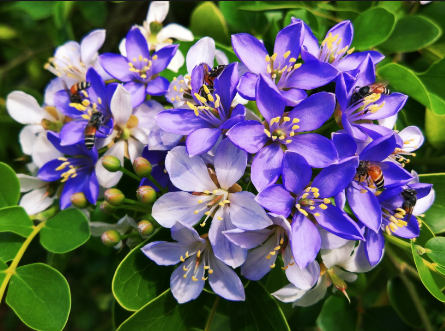
Knowledge about
"Lignum Vitage" flower, the
symbol of Suan Sunandha Rajabhat
University. Lignum
Vitage, also known as "Water
Jasmine," has a scientific name
Guaiacum offinale Linn. It is a small to
medium-sized tree with non-deciduous
leaves, characterized by crooked stems,
knobbed branches, bushy appearance, and
beautiful brown to dark greenish-black
wood. It blooms in purple or light blue
flowers with 5-6 petals, has yellow
pollen. It blooms during the winter from
November -
February. History The
history of the Imperial Gardenias are
varieties of wood different region has
its roots in Central America, South
America, and Florida, this is also the
national flower of Jamaica brought to
Thailand since the time of King Rama V
during his visit to Java, Indonesia.
Encountered this beautiful tree and
therefore ordered to create a
"forest park." King Rama V
have brought the crystal back and
planted it in the area of the Phra
Ratcha Uthayan Wang Suan Sunanta Park
(currently known as Suan Sunandha
Rajabhat University). This has turned
the crystal into the symbol flower of
Suan Sunandha Rajabhat University. The
original tree was originally located at
the Phra Borom Rachanuson Queen Sunandha
Kumariratana Phra Borommaratchawong Ther
Temple in the reign of King Rama V, or
known as the area behind the Queen's
Mound. After that, Her Majesty
Queen Sirikit, Princess of Thailand,
bestowed a new name as "Kaew
Jotjom" and later, in the year
1958, Professor Tem Smitinand renamed it
"Kaew Chaojom," which is the
name used today. The benefits
of the Kaew Chaojom flower. In
ancient times, the elderly would refer
to the Kaew Chaojom tree as the
"Tree of Life" (Wood of life)
or the auspicious tree. In traditional
medicine, Guaiacum officinale, when
extracted as herbal medicine, can help
strengthen the body and treat various
diseases. Guaiacum officinale has
medicinal properties as
follows: 1. Used to treat chronic
rheumatism, arthritis, menstrual cramps,
asthma, and diabetes. 2. Used in
forensic medicine as a blood-stain
reagent called Gum Guaiacum. 3.
Dried flowers are brewed into tea for
nourishment. 4. Rubber wood is
used as an expectorant, laxative,
diaphoretic, anti-inflammatory, blood
purifier, remedy for flatulence,
diarrhea, bronchitis, abdominal pain,
and wound healing. 5. Leaves are
used for making a decoction to relieve
feverish stomach. 6. Bark and
flowers are beneficial as a
laxative according to the auspicious
glass book, the sacred tree. From
the village doctor's website. https://kaset.today/